
Trace Back the Former Owners of a Bibb County Property
Work backward, one deed at a time. Start from the newest reliable reference. Then move from buyer to seller until the trail runs out. Bibb County splits its online property records into two eras: the Probate Office handles land records from 1996 to the present, and RecordHub covers 1819 through 1995. Older cataloged deed and probate series point to volumes that may need staff help, microfilm, or an in-person visit.
The legal description holds the chain together. Names change, and roads get renamed. One deed may even cover several tax parcels. Match the lot, block, addition, or acreage, along with the section-township-range language or deed book and page, before treating two same-name entries as one property. That wording is your proof.
| Source | Years It Covers | Where Held | What It Shows |
|---|---|---|---|
| Current Probate land records | 1996-present | Bibb County Probate portal | Indexed instruments and recorded images, subject to account access |
| Historic land-record route | 1819-1995 | RecordHub, linked by Probate | Earlier deed-index and land-record leads |
| Deeds and deed index | Deeds 1824-1902; index 1824-1900 | FamilySearch catalog / Probate / archives | Book-era grantors, grantees, and descriptions |
| Probate and administrators' records | 1818-1930; 1821-1942 | Probate, FamilySearch, Alabama Archives | Estate transfers that may not resemble an ordinary sale |
Start in the era of the most recent transfer. If the current parcel record cites a 1990 deed, take the historic route first. A last transaction after 1996 points you to the current portal instead. The catalog dates describe series only. They promise neither full images nor complete coverage.
Bibb County's 1996 Deed-Search Divide
The Bibb County Probate Office is the authoritative first stop. Its page separates current land records from historic ones. Current recording access requires a free account. The portal announced account access beginning August 1, 2026. For 1819 through 1995, RecordHub is the county-linked route for deed records.
Search both sides when a chain crosses 1996. Save the instrument type, recording date, book or page number, and the exact legal-description wording. A portal index is a finding aid only. Obtain the full image or a certified copy before relying on any clause, reservation, or signature.
The county's recording entry displays the free-account notice and login fields. Open the official recording login to compare that screen with the current version.
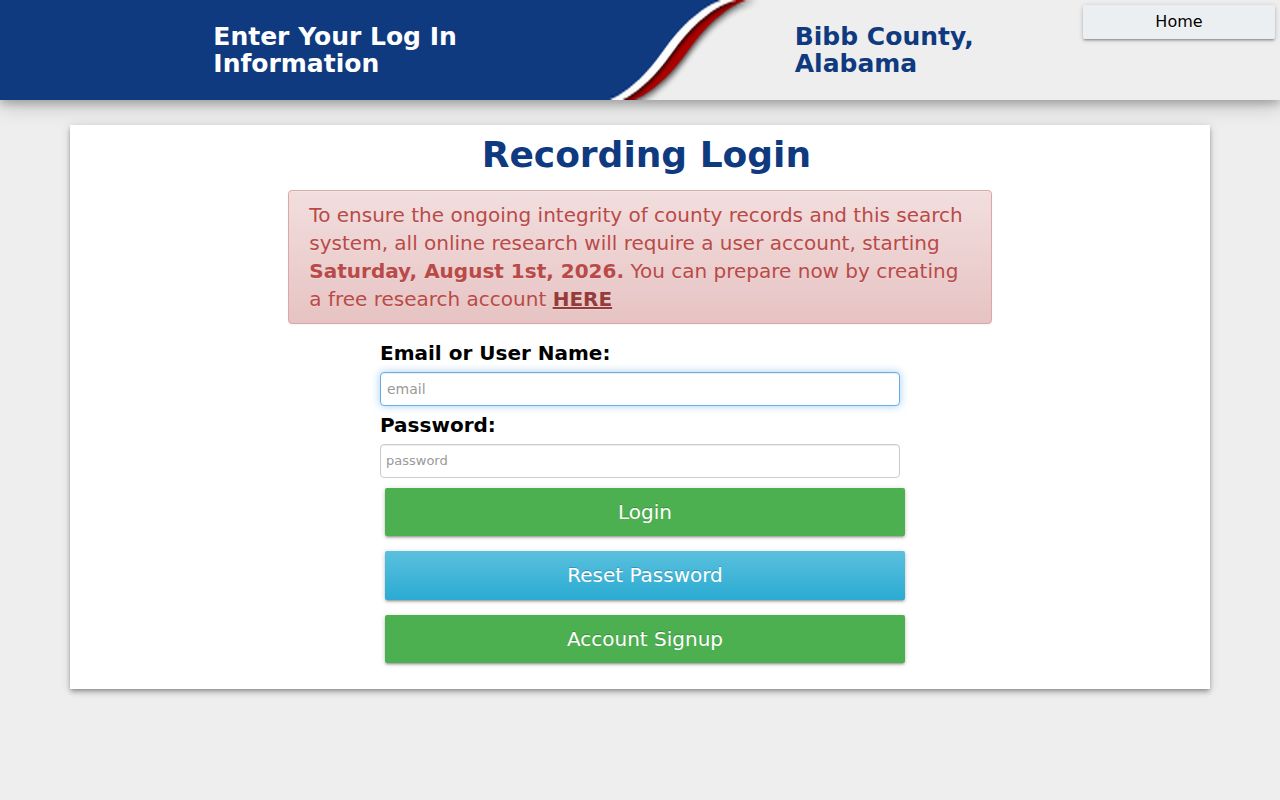
That screen confirms the access gate. It does not prove that a named person or parcel has a recorded deed.
Fix the Starting Deed Before Going Back
Start with the Bibb Public GIS and treat it as a tip sheet, nothing more. Note the displayed owner, the account, the parcel number, and any deed book, page, and deed date shown alongside the physical address and subdivision. Legal-description fragments help too. The county's own disclaimer on the GIS says it is not an official ownership record, and the tax roll it draws from can lag behind recorded transfers. So take what it displays as a lead.
The next step belongs at Probate. Pull the newest recorded deed and read its grantee against the parcel description you gathered. Mismatches happen. A lot. Splits, mergers, corrective deeds, estate proceedings, court orders, and delayed assessment updates all break neat chains. When the records disagree, trust the recorded conveyance and dig into why the gap exists rather than forcing the ownership history to line up.
Walk the Bibb County Deed Chain in Reverse
The core technique is simple. Turn each seller into your next buyer search. Working from the newest deed backward, keep a citation log at every step so a similarly named person never silently replaces the correct party in the deed records.
- Find the newest purchase deed and verify that its legal description matches the subject tract.
- Record the grantor, who is the prior owner or transferring party named on that instrument.
- Search that grantor as an earlier grantee, testing initials, suffixes, spouses, and entity-name variants.
- Repeat until the trail reaches 1996, then continue in RecordHub and book-era indexes.
- Grantor / grantee
- The transferring party and receiving party named by the instrument; usually seller and buyer, but not always.
- Chain of title
- The ordered sequence of instruments affecting the same land, not merely a list of tax-roll names.
- Legal description
- The lot, block, survey, acreage, or section language that identifies land more reliably than a street address.
When a Bibb Ownership Chain Passes Through an Estate
Ownership in Bibb County sometimes skips the normal deed trail. Title can pass through a will. It can also move by a probate order, an heirship proceeding, an administration, or a court judgment. Bibb's cataloged Probate Court records start in 1818. Administrators' records begin in 1821. Wills begin in 1900. Treat those years as collection ranges rather than full online coverage.
Search the decedent's name in the probate records. Hunt for an inventory, an order, an administrator's deed, or a later conveyance signed by heirs. Then confirm the transfer in the Bibb County deed records. A family-history source may clarify names. But only the recorded instrument or probate order proves title.
Old Bibb Descriptions Outlast Modern Addresses
Bibb County GIS maps still carry historic labels worth knowing. Tokens like RODEN COAL, COOPER ADDN TO BRENT, FAIRS ADDN TO CENTREVILLE, WOODSTOCK ESTATES, and quarter-section survey names can link a modern parcel to a book-era deed. They cannot, on their own, establish a subdivision boundary or a development date.
Copy the details exactly as written. For a town lot, that means the addition, lot, block, and plat reference. For rural acreage, keep the bearings, distances, waterways, roads, adjoining owners, and section-township-range calls. Search each name exactly as printed. Keep the abbreviations, too. Only then try a normalized version of the Bibb County property records entry.
The 1973 Tornado and Bibb's Genealogy Trail
The Brent/Centreville Library began in Brent City Hall back in 1949. The 1973 tornado destroyed most of Brent. The library was among the losses. Its present Centreville building opened in 1982. Today the genealogy collection spans cemetery records, census materials, church histories, and local-history titles. Any of these can clarify a surname. A place name in an old Bibb County deed may also come clear.
Treat the library as a lead rather than title proof. Whatever you find there gains strength when paired with the Alabama Department of Archives and History, the FamilySearch Bibb catalog, and the original Probate volume itself. Alabama Archives cautions that most physical county records stay with the office that created them. A trip to the county courthouse may still close the gap.
Note: Always verify a past-owner lead against the original recorded deed before relying on it.
Check Every Prior-Owner Link for Exceptions
Deeds rarely tell a clean story. One may reserve mineral rights, carve off acreage, or grant an easement across the land. Another corrects a flawed legal description or moves several parcels in a single conveyance. Mortgages, releases, tax-sale certificates, quiet-title orders, and plats can all shape ownership. None of these are ordinary owner-to-owner transfers. That is why the recorded image matters more than the index line.
Keep careful notes. Record the source URL, the access date, and the instrument identifier. Note the parties, the property description, and any unresolved questions. A reconstructed timeline is not a title search. For a certified chain of title, consult the Probate Office and an Alabama title professional.
Build a Bibb Ownership Timeline With Source Citations
Structure the timeline around instruments, not people. Each row should capture execution and recording dates, grantor and grantee, instrument type, book/page or instrument number, legal-description match, portal or volume, and unresolved exceptions. Laid out this way, overlaps, gaps, and corrective deeds stand out where a simple former-owner list would hide them.
Preserve capacity exactly as written. Spouses, heirs, trustees, companies, and government entities often appear in Bibb County property records with a stated role. Do not flatten "personal representative" or "trustee" into an ordinary individual owner. Search surname and entity variations too. Still, connect records only when dates and land descriptions agree.
Historical catalogs can widen the net. The FamilySearch Bibb catalog lists mortgages from 1876-1898, guardianship material from 1823-1916, wills from 1900-1935, and selected court files. Any of these may explain a transition. The final title link, however, still requires the relevant recorded instrument or a court or probate order.
How Far Back Bibb County Ownership Records Reach
Bibb County dates to 1818. The county-linked historic land-record route reportedly begins in 1819, and the FamilySearch catalog lists deed records from 1824-1902 with a deed index covering 1824-1900. Earlier transfers, or those outside deed records, may lead into probate files, administrators' records, state archives, or federal land records. Treat these ranges as signposts, not proof of a continuous online chain.
At the courthouse, ask for the index entry, the deed book and page, the image or volume, the certification option, and any separate plat. Remote researchers can call the Probate Office at 205-926-3104 before mailing a request or traveling to 8 Court Square W, Suite A, Centreville.
Lawful use. Research former owners for house history, estate work, boundary questions, and purchase diligence. Do not republish unnecessary personal details or use public records to stalk, harass, threaten, or harm anyone.