
Find Out Who Owns a Bibb County Property
Bibb County splits the ownership question between two systems. The free county GIS map is the fastest way to move from an address to a parcel number. The Probate Office recording trail then supplies the deed records that prove title. Work the sequence in order. Keep tax data, title, occupancy, and mailing details separate. Do not blend them into one answer.
- Enter the street number and street name in the Bibb GIS parcel search; compare parcel number, acreage, subdivision, and map location before accepting a match.
- Record the displayed owner/tax name, deed book/page, deed date, legal-description clues, and the date of your search.
- Use the Probate Office's 1996-present land-record route to locate the newest deed; use RecordHub for the 1819-1995 band when needed.
- Compare the deed's grantee and legal description with the GIS parcel. If the grantee is an entity, research that exact entity separately.
“Owner” Has Several Bibb County Meanings
The word "owner" carries several meanings in Bibb County records. A name on the GIS parcel is a tax-roll entry. It is not a guarantee of title. A deed grantee is whoever received the interest described in that recorded instrument. An estate representative can sign and act for the property without benefiting from it. Mortgage holders and lien claimants hold interests too, though not ownership. Permit applicants and occupants may be someone else entirely.
- Owner of record
- The name carried on a particular official roll or recorded instrument.
- Grantee
- The person or entity receiving the interest stated in a deed.
- Title
- The legal ownership interest, evaluated from the complete record rather than one index field.
- Situs address
- The physical property location; it can differ from the owner's mailing address.
Decide what you are really asking first. "Who receives the tax bill?" and "who holds record title?" are two different questions in Bibb County, even when the answers overlap.
Where Bibb County Ownership Names Appear
Each public source plays a distinct role. The GIS map identifies the parcel. The newest recorded Probate instrument confirms the transfer. The strongest answer draws on both, while respecting the limits of each record.
| Ownership source | What the name means | Practical access |
|---|---|---|
| Bibb tax assessment/GIS | Tax-roll name, mailing clues, parcel attributes | Free public GIS; assessor phone/in-person fallback |
| Bibb Probate deed index | Grantee on the newest applicable recorded transfer | Current account portal, historic RecordHub, or office |
| Alabama Secretary of State | Entity record, agent, and associated filing information | Official business-entity search |
| Circuit Clerk/AlaCourt | Parties and orders in quiet-title, partition, or foreclosure litigation | Online read-only service or clerk file request |
No source in the table proves occupancy. A Bibb County tax mailing address can help with a property-related letter, but it may be a post-office box, a business address, or even a different property. Match names through parcel numbers and legal descriptions. Never rely on proximity or guesswork.
Bibb's Current Deed Search Requires an Account
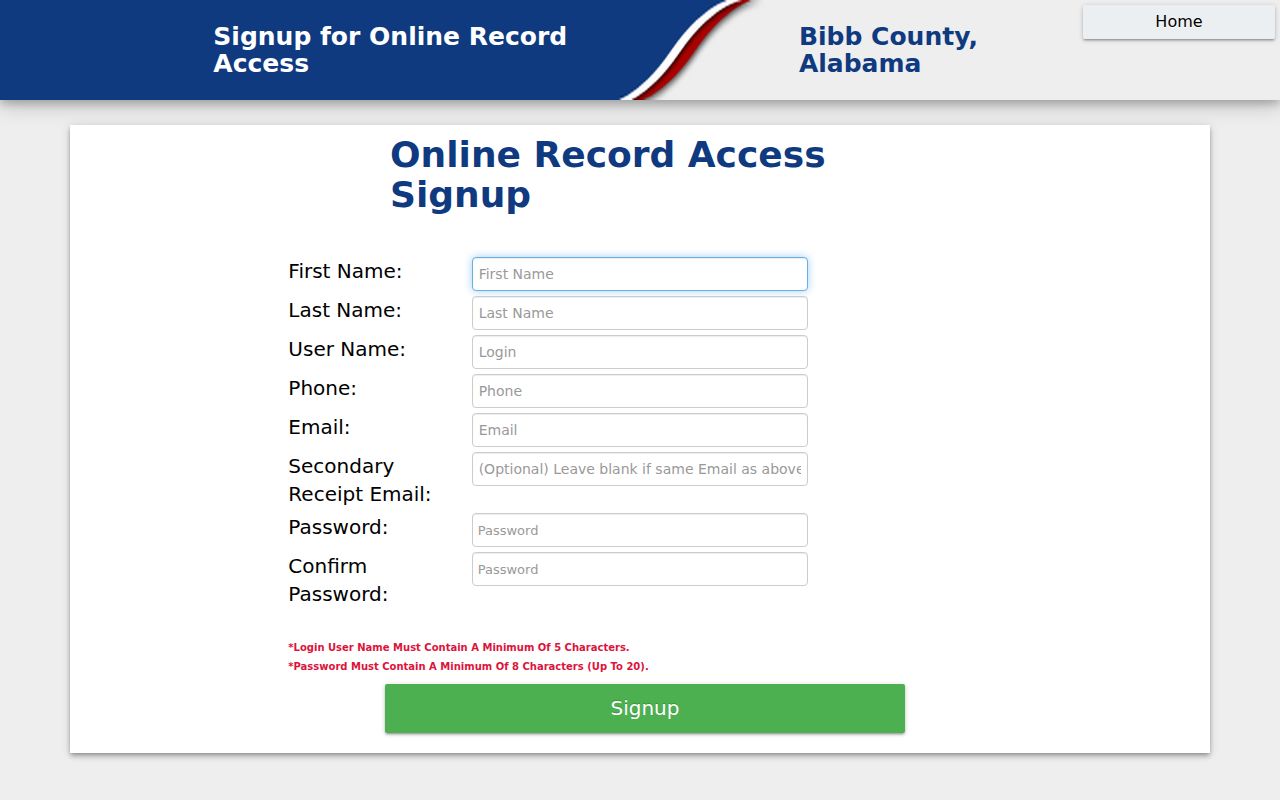
Bibb's current recording portal requires a free user account for online research. That requirement starts August 1, 2026. Signup collects a name, username, phone, email, an optional secondary receipt email, and a password. The gate limits online access only. It says nothing about whether the Probate Office holds the instrument you need. The official Bibb recording signup page shows this channel and its requirements.
If the account route fails, call the Probate Office. You can also visit it at 8 Court Square West, Suite A, Centreville, 205-926-3104. Give the staff the owner name variants, the parcel number, and the legal description. Include any deed book and page or date range you have. Ask for the newest applicable recorded instrument or a certified copy. A blocked portal is not a negative result; the deed records still exist in the office.
Note: Current records route to the 1996-present portal, and RecordHub is the county's route for 1819-1995 land records.
Identify Entity and Estate Ownership Without Guessing
The latest Bibb County deed may name an LLC or corporation. Search that exact grantee in the Alabama Secretary of State business records. Pull the entity number, status, agent, and filing details. Then return to the deed to see what interest the entity actually received. An agent is a contact role, not automatically the beneficial owner of the land.
Trusts and estates call for the same care. A deed may name a trustee or a personal representative. A Probate case documents the authority behind that name or a later distribution. Search Probate cases and recorded instruments together, using name variants. Vital records can support identity or succession questions when access rules allow it. They cannot transfer a parcel on their own.
A Bibb Court Order Can Alter the Ownership Trail
Court orders can rewrite the ownership trail in Bibb County. Quiet-title suits, partitions, foreclosures, and lien-enforcement cases all change who holds title. Search the Bibb County Circuit Clerk by party name or case information. Alabama's Just One Look service works the same way. Online access is read-only. Some images and features require an account or subscription.
A final judgment is not the end of the trail. Look for the order or resulting instrument recorded with Probate. Match its legal description to the parcel. If online court records run thin, request the specific case component from the Circuit Clerk at 35 Court Square East, Centreville, 205-926-3103.
Build a Five-Record Bibb Ownership Check
For an answer that matters, assemble a parcel identity packet from Bibb County sources. Include the GIS parcel card and its disclaimer, the latest deed or index entry, current mortgage, release, lien, and easement searches, the assessment and tax record, plus municipal zoning or town-limits evidence when jurisdiction is in play. Add a court docket only if a dispute surfaces.
Comparing the records exposes familiar mismatches. The tax roll may still carry the seller's name. A deed may rely on an older subdivision description. An entity name may be abbreviated differently across documents. A municipal record may point to an applicant who never owned the land. Date each source. Label conflicts you cannot resolve instead of collapsing them into one confident statement about the owner of record.
When a Bibb Owner Search Produces Nothing
A dead end online rarely means the record is gone. A GIS Basic Search error, an account-gated Probate portal, or hidden AlaCourt fields simply blocks one path to the same Bibb County records. The parcel still exists. The deed still sits in its book.
Work around the technical walls. Retry the parcel number first. Try an owner search set to “contains,” a street name without its road type, exact subdivision wording, or a deed book and page. Date bands help too. Each tweak often surfaces what the first query missed.
If the screen still fights you, change channels. The assessor can confirm parcel identity by phone or in person. Probate holds the recorded instrument. The Circuit Clerk keeps the court file you need. For a public record no office supplies outright, ask the custodian for a written request under Alabama Code §§36-12-40 and 36-12-45.
What “Who Owns This Property” Cannot Establish
A name on a screen settles less than people assume. It is not a title opinion, not proof of possession. It is not confirmation of who actually lives at the Bibb County address. A deed conveys only the interest its grantor held. An index can also omit qualifications that appear in the recorded image itself.
Plenty of ownership questions need their own digging. Tax sales, mortgages, liens, easements, probate interests, and court orders each demand separate analysis. For those tasks, turn to the current owner record and the former-owner chain. The deed records guides round it out.
Lawful use. Use Bibb County owner information only for legitimate property research, such as purchase diligence, boundary questions, estate work, or a respectful property-related contact. Never use it to stalk, harass, intimidate, or harm anyone.