
Fields in Bibb County Property Tax Records
The Bibb Tax Assessor/Collector keeps the local assessment and collects the tax. Read every amount together with its year, class, exemptions, and taxing district so the number means something.
| Field | What It Shows | Where |
|---|---|---|
| Appraised value | Value before classification | Assessor |
| Assessed value | Appraised value times class percentage | Assessor |
| Exemptions | Eligible adjustments to taxable value | Assessor |
| Tax and status | Bill, payment, or delinquency information | Assessor/Collector |
| District and millage | Levies applied to the assessed base | Assessor/Collector |
Alabama computes tax from assessed value and millage after subtracting any exemptions that apply. Keep the figure in perspective. A tax value is neither the consideration named in a recorded deed nor a sale appraisal.
Bibb GIS Supplies the First Tax Clues
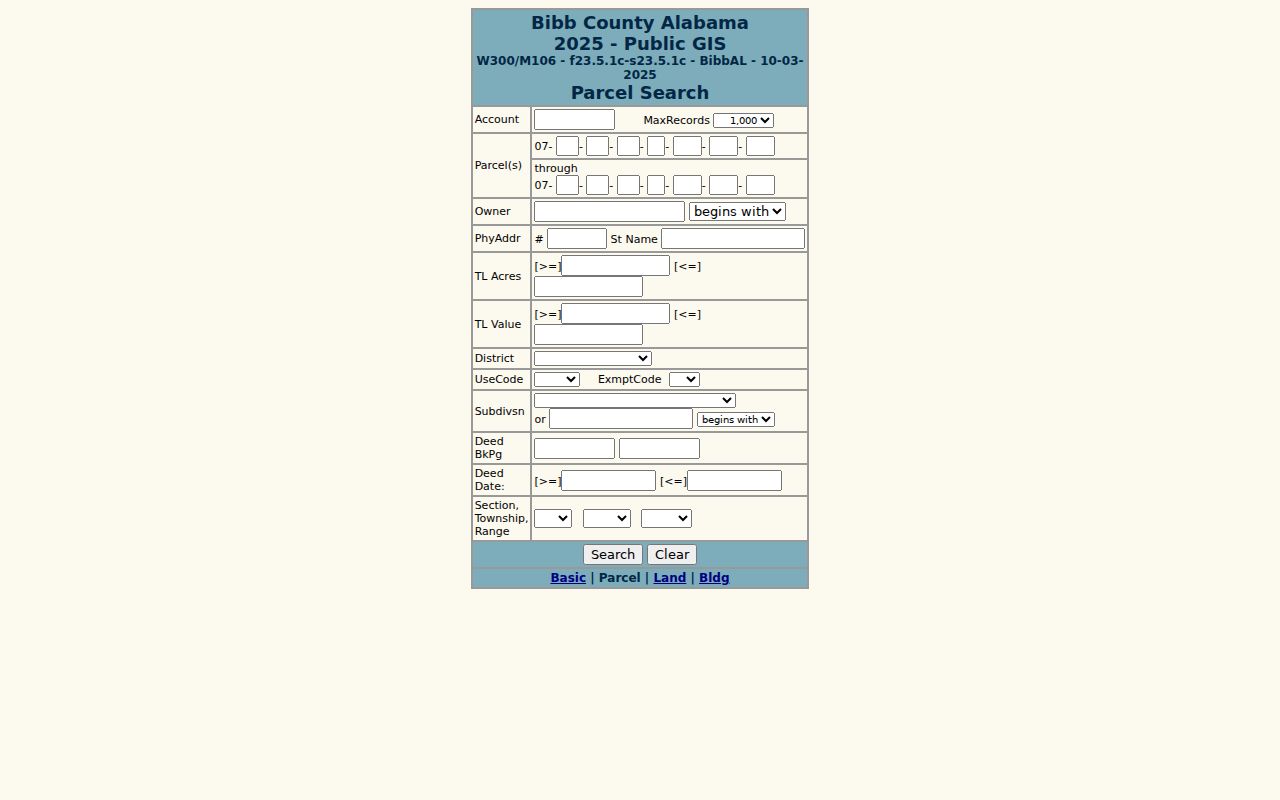
The Bibb GIS form takes a wide range of inputs. Owner name, physical address, parcel, acreage, value, district, use code, exemption code, subdivision, deed references, and land-grid fields all work. The form does not decode its own abbreviations, so confirm unclear codes with the assessor instead of guessing.
| Field | Use | Caution |
|---|---|---|
| TL Value | Value-range filter | Not sale price |
| ExmptCode | Exemption-coded records | Meaning not shown |
| District | County or listed city filter | Not proof of city limits |
| Owner | Tax-roll name | Can lag a deed |
| Parcel | Exact account clue | Keep local format |
The captured form reflects the 2025 release.
Carry the parcel and tax year into a direct office request.
Request a Bibb County Tax Bill
Bibb County publishes no separate online bill portal. Begin with GIS to locate the parcel, then contact the Assessor/Collector at 8 Court Square West, Suite B, Room 102, Centreville, AL 35042, 205-926-3105.
- Find the address or parcel in GIS.
- Copy the parcel, name, district, and displayed value.
- Request the tax card, bill year, balance, exemptions, and status.
- Ask the office to explain codes and mismatches.
- Assessed value
- Appraised value after classification.
- Millage
- The levy applied to assessed value.
- Homestead exemption
- An eligibility-based adjustment.
- Tax lien
- A claim arising from unpaid tax.
Bibb County Property Tax Calendar
ALDOR states that property tax comes due October 1 and turns delinquent after December 31, with sale steps advancing in spring. The state page lays out that calendar for every county. Always confirm live parcel status with Bibb County itself.
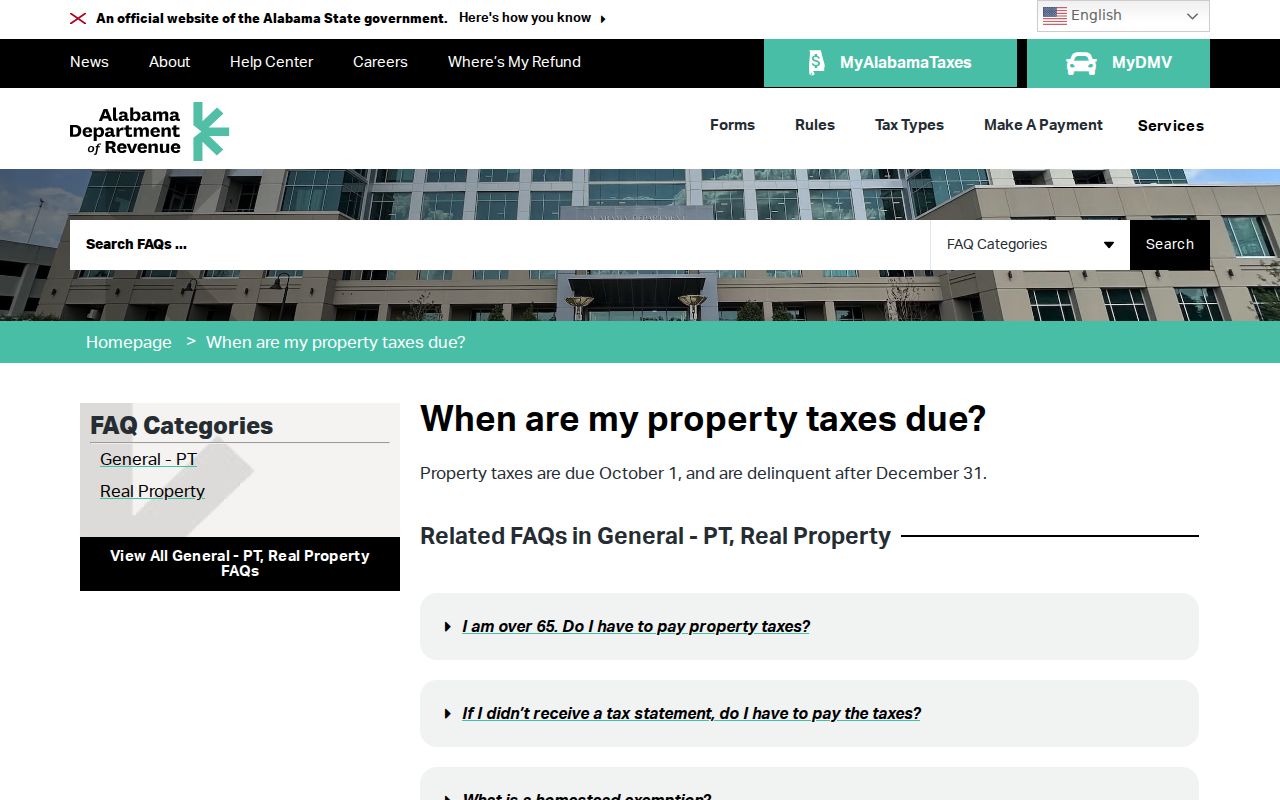
A published timetable does not replace a current Bibb balance or sale-status check.
Homestead and Current Use Differ
Alabama recognizes H-1 through H-4 homestead categories, each with its own rules. Current use is a separate program. It can cover qualifying agricultural, forest, residential, or historic land, and it carries transfer and rollback consequences that homestead exemptions do not. Read the state homestead guidance first. Then ask Bibb County what proof, deadline, and local process apply to a specific parcel. A code on a search result never proves eligibility.
Bibb Tax-Sale Records Need Verification
ALDOR describes the auction process, redemption rights, the Book of Lands, and property-tax transcripts. Bibb County publishes no current sale list online. Request the status of the exact parcel from the county. Paying someone else's delinquent tax creates no ownership by itself. Before drawing any title conclusion, check the sale record, redemption, Probate recording, and any related court file.
A Transfer May Leave a Stale Tax Name
A buyer should record the deed and assess the parcel correctly from the start. Until the tax roll updates, the former owner may still show as the owner of record. Compare the tax entry against the latest Probate instrument. Report address changes in writing. Keep the parcel number, tax year, submission date, and county response so a mismatch becomes a correction you can trace.
Contest a Bibb County Assessment Promptly
ALDOR requires a written protest to the county Board of Equalization within 30 days after written notice, citing Alabama Code §§40-3-20, 40-3-24, and 40-3-25. Confirm the exact date and delivery method locally. Strong support includes the notice, parcel card, acreage, classification, comparable records, photos, and proof of an exemption or factual error. Keep a filed copy. Keep delivery evidence too.
Appeal window. State guidance uses 30 days after written notice. Verify the Bibb County deadline and file with the Board of Equalization on time.
Read a Bibb County Tax Record in Context
Start any Bibb County property tax search by fixing the parcel and the tax year. Addresses change. Owner names can lag behind a recorded transfer. The parcel number stays stable across rolls, so use it as your anchor. Save the GIS release and query date. Then ask the Assessor/Collector to confirm the current tax card, classification, acreage, exemptions, district, assessed value, bill, balance, and status. For historical comparison, request the specific prior years. Do not assume the public form holds a complete value history.
The state formula explains why similar-looking figures differ. Appraised value passes through the applicable classification percentage to produce assessed value. Millage and qualifying exemptions then shape the final tax. Current-use treatment follows its own rules and can make a comparison with nearby property misleading. Compare like with like: similar acreage, class, use, district, exemption treatment, and assessment year. A transfer price belongs to the deed record, not to any of these tax fields.
Due dates also need a year-specific check. Alabama guidance sets the due date at October 1 and delinquency after December 31. But a general calendar cannot tell you whether a particular Bibb parcel is paid, delinquent, advertised, sold, redeemed, or in the Book of Lands. Ask the county for the current status and keep the office response. Published legal notices can yield a parcel, party, or book-page clue. The county and Probate records must verify it.
Exemption research should separate the program from the code displayed online. H-1 through H-4 categories carry different eligibility conditions. Current use is not simply another homestead label. Ask what proof is required, when it must be filed, and how a transfer affects the benefit. Never conclude that a parcel qualifies just because GIS shows an unexplained exemption code.
For an appeal, count the deadline from the actual written notice. Confirm receipt rules with the Bibb Board of Equalization. Organize the evidence by disputed fact, whether wrong acreage, classification, building details, condition, exemption, or unequal treatment. Include the notice, parcel card, clear photos, relevant records, and comparable parcels chosen on consistent terms. Filing within the stated period preserves the issue. A casual phone call does not.
A Bibb County tax record makes the most sense when you keep four dates apart: the assessment year, the bill due date, and the date on any written value notice. The fourth date, a visit to an online record, matters far less than those. Always confirm the mailing address the office has on file. Keep copies of anything you submit in writing. When the name on the tax roll clashes with a recent deed, report the mismatch to the office instead of guessing that the deed failed. If a GIS map leaves out history or code explanations, ask the custodian for it under Alabama's public-record procedures. Handled this way, Bibb County property tax records stay useful without claiming a tax screen proves more than it does.
Share tax records with their year and source intact. Never present an old balance as a current one. Skip personal details that have nothing to do with the parcel question. And before any payment, appeal, sale-status inquiry, or public statement, recheck the figures with the office.